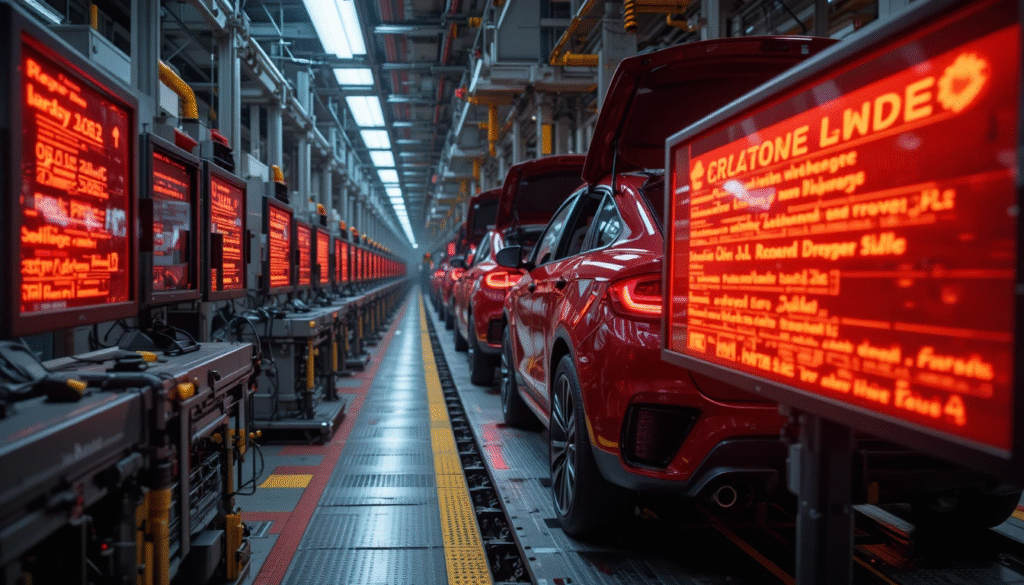
Jaguar Land Rover faces a massive operational crisis after a cyberattack crippled global production lines, leading to widespread shutdowns, severe financial losses, and renewed scrutiny of automotive cybersecurity resilience.
Introduction
Jaguar Land Rover (JLR), one of the world’s most iconic automotive manufacturers, has become the latest victim of a devastating cyberattack that has forced a complete shutdown of its global production network. The incident, which surfaced earlier this week, disrupted factory operations in the United Kingdom, India, and several other regions, bringing vehicle manufacturing to a grinding halt.
According to company officials, the cyberattack targeted core production and logistics systems, rendering them inoperable and forcing immediate suspension of manufacturing activities. The breach, reportedly involving a sophisticated ransomware variant, has caused significant financial damage, with early estimates suggesting losses amounting to tens of millions of dollars per day.
The attack’s timing couldn’t be worse, arriving amid a critical global supply chain recovery phase and growing dependency on digital systems in the automotive sector. Cybersecurity analysts warn that such incidents highlight the fragility of interconnected production systems and the rising cyber threat to industrial operations worldwide.
This large-scale disruption has raised urgent questions about cybersecurity preparedness in the manufacturing sector, particularly for brands like JLR that rely on complex, globalized supply networks. Investigations are currently underway, and while the company has yet to confirm the attackers’ identity, experts believe this event marks one of the most severe cyber incidents in automotive history.
Background
Jaguar Land Rover, a British multinational luxury car manufacturer, has long been recognized for innovation, design, and engineering excellence. However, its digital transformation journey—designed to modernize production and supply chain efficiency—has also introduced new vulnerabilities.
In recent years, the automotive industry has increasingly adopted automation, connected devices, and digital control systems to enhance productivity. While these advancements have streamlined operations, they have simultaneously opened the door to cyber threats targeting manufacturing environments.
Cyberattacks on industrial systems have surged by nearly 35% globally since 2022, according to a report by Check Point Research. Ransomware groups such as LockBit, BlackCat (ALPHV), and Clop have aggressively targeted automotive supply chains due to their dependency on real-time data systems and limited downtime tolerance.
JLR’s current incident follows a series of high-profile attacks across the automotive industry. In 2023, Toyota experienced a production outage in Japan due to a supplier’s cyber breach, while Continental AG confirmed data theft by ransomware actors.
Experts argue that cybercriminals are increasingly drawn to high-value manufacturing operations where disruptions can cause immediate financial and logistical chaos. The JLR breach demonstrates the potential scale of economic and reputational fallout when production systems are compromised.
With global production sites interconnected via enterprise systems, even localized attacks can trigger cascading effects across continents. JLR’s reliance on integrated manufacturing technologies—ranging from IoT-driven assembly lines to cloud-based logistics—may have amplified the attack’s impact.
This event underscores the urgent need for automakers to reassess their cyber resilience strategies, invest in segmentation of critical systems, and implement real-time threat monitoring within industrial networks.
Core Details
a) Key Event & Specifics
The cyberattack reportedly began as a coordinated ransomware campaign targeting JLR’s central production management servers. Sources close to the investigation revealed that attackers gained access through compromised vendor credentials, exploiting weak endpoint security within the supply chain network.
Once inside, the attackers deployed an encrypted payload that rapidly spread across JLR’s enterprise systems. Automated assembly lines, digital supply chain tools, and order processing systems were rendered inoperative. The company immediately initiated an emergency response protocol, shutting down critical servers to contain the infection.
Preliminary digital forensics suggest the use of a double-extortion ransomware technique, where attackers not only encrypted operational data but also exfiltrated sensitive design and manufacturing documents. The attackers reportedly demanded a ransom payment in cryptocurrency, threatening to leak proprietary data if the company refused to comply.
JLR’s IT teams, supported by external cybersecurity firms and UK government cyber units, are currently engaged in system restoration efforts. The company has yet to confirm if any customer data has been affected.
b) Impact on Stakeholders
Businesses:
The immediate impact on JLR is severe—production losses across multiple plants have disrupted vehicle delivery schedules and supplier contracts. Financial analysts estimate that the company could face losses exceeding $200 million if production remains halted for another week.
Consumers:
Customers awaiting vehicle deliveries are likely to experience delays of several weeks. Retail operations and after-sales services are also disrupted due to the unavailability of production data and component tracking systems.
Governments & Regulators:
The UK’s National Cyber Security Centre (NCSC) has launched an investigation, coordinating with law enforcement agencies to trace the origin of the attack. The breach has reignited calls for stricter cybersecurity compliance within critical manufacturing infrastructure.
This cyber incident also serves as a wake-up call for global policymakers pushing digital transformation initiatives in the automotive sector.
c) Expert Analysis & Commentary
Cybersecurity experts have described the JLR cyberattack as a “watershed moment” for the automotive industry.
“The sophistication and scale of this attack suggest a well-funded group, possibly with state-backed capabilities,” said Dr. Elisa Morgan, Senior Cyber Threat Analyst at Kaspersky.
“The automotive supply chain is now a prime target due to its complexity and interconnected digital systems,” added Michael Turner, CTO at SecureWorks UK.
Analysts emphasize that the attack aligns with a broader trend of ransomware-as-a-service (RaaS) operations, where cybercriminals lease attack tools to affiliates targeting large enterprises.
JLR’s situation also exposes a critical flaw: over-reliance on centralized systems without sufficient segmentation. Experts recommend Zero Trust architectures, real-time threat detection, and regular security audits to mitigate such risks in the future.
d) Industry & Market Reaction
The global automotive market reacted sharply following news of the cyberattack. Tata Motors, JLR’s parent company, saw its stock dip by 4.8% on the Bombay Stock Exchange. Suppliers across Europe and Asia have reported temporary halts in shipments due to synchronization issues with JLR’s network.
Competitors like BMW and Mercedes-Benz have issued statements expressing solidarity while reaffirming their commitment to strengthening cyber defenses.
Meanwhile, cybersecurity firms are witnessing a spike in demand for Industrial Control System (ICS) security solutions as manufacturers scramble to assess their vulnerabilities.
Industry observers predict that this event will accelerate the adoption of AI-powered security monitoring, supply chain risk assessments, and multi-layered network defenses across the sector.
e) Global & Geopolitical Implications
The attack on JLR could have far-reaching global repercussions. As automotive supply chains rely heavily on just-in-time production models, any disruption can ripple across continents.
Geopolitical analysts suspect that the attack may not be purely financially motivated. Some experts suggest potential links to state-sponsored groups seeking to disrupt UK-based industries amid escalating global cyber conflicts.
If confirmed, this would mark a significant escalation in cyber warfare targeting industrial infrastructure—a pattern previously seen in energy and logistics sectors.
For now, governments are intensifying cross-border collaboration on cyber intelligence sharing and enforcing stricter penalties on ransomware groups operating from safe-haven regions.
Counterpoints & Nuance
While the cyberattack has been labeled catastrophic, some analysts argue that its long-term impact might be contained. JLR’s robust recovery framework and global data backups may help resume operations within weeks.
A company spokesperson downplayed speculation about data leaks, emphasizing that no customer or financial data breaches have been confirmed. Critics, however, argue that the company’s initial response was slow, potentially worsening downtime.
Cybersecurity skeptics also warn against attributing the attack prematurely to nation-state actors, citing the growing prevalence of opportunistic ransomware affiliates.
The mixed reactions reflect a complex truth: while cyber resilience is improving across industries, complete immunity from cyber threats remains unattainable.
Future Outlook
In the coming months, JLR is expected to undertake a full-scale cybersecurity transformation. Industry insiders suggest the company will prioritize AI-driven threat detection, supply chain security, and employee awareness programs to minimize future risks.
Governments may also impose stricter cybersecurity standards for industrial operators under critical infrastructure protection frameworks.
This event could serve as a case study for the entire automotive sector—highlighting the urgent need for redundancy, segmented networks, and proactive threat intelligence sharing.
While JLR focuses on recovery, cybersecurity experts predict a surge in similar ransomware attempts across manufacturing firms in 2026 and beyond. The global lesson is clear: cybersecurity is no longer an IT expense but a strategic business necessity.
Understanding the Basics
What Is a Ransomware Attack?
Ransomware is malicious software that encrypts files and demands payment for decryption. Attackers often threaten to leak data if the ransom isn’t paid—a tactic known as double extortion.
Why Target Manufacturing?
Manufacturing companies like JLR operate on tight production timelines. Even an hour of downtime can lead to significant losses, making them prime targets for extortion.
How Are These Attacks Carried Out?
- Phishing Emails: Used to steal credentials.
- Exploiting Vulnerabilities: Attackers use known system flaws.
- Insider Access: Compromised vendors or employees.
- Data Exfiltration: Sensitive data is stolen before encryption.
Prevention Measures:
- Implement Zero Trust architecture.
- Segment operational networks.
- Conduct regular penetration testing.
- Maintain offline backups.
- Train employees to recognize phishing.
Future Defense Trends:
- Adoption of AI-powered intrusion detection.
- Integration of threat intelligence platforms.
- Emphasis on cyber hygiene and governance frameworks like ISO 27001.
Conclusion
The Jaguar Land Rover cyberattack underscores a sobering reality: even the most advanced enterprises remain vulnerable in the digital era. The incident not only disrupted global production but also exposed the deep interdependence between cybersecurity and industrial continuity.
While investigations continue, this attack serves as a pivotal reminder that cybersecurity must be embedded into every layer of manufacturing and supply chain operations.
For the automotive industry and beyond, resilience lies not in avoiding attacks but in building systems capable of withstanding and recovering from them swiftly.