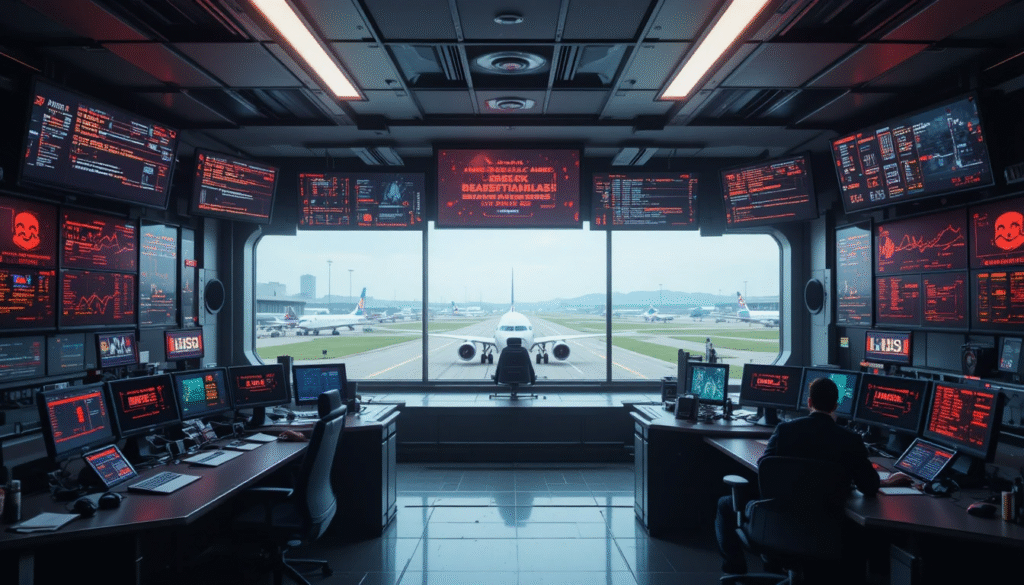
A large-scale ransomware attack has paralyzed airport operations across Europe, disrupting thousands of flights, stranding passengers, and raising serious concerns about cybersecurity resilience in the aviation sector.
Introduction
A massive ransomware attack has struck several major European airports, leading to widespread disruption and grounding thousands of flights. The cyberattack, detected early Thursday morning, targeted airport IT systems and flight management servers across the United Kingdom, France, Germany, and the Netherlands.
According to initial reports, the attack used a highly sophisticated ransomware variant capable of encrypting operational systems, baggage handling networks, and air traffic management tools. Authorities believe the attackers exploited vulnerabilities in third-party service software connected to airport infrastructure.
The incident began around 4:30 AM GMT, when systems at Heathrow, Charles de Gaulle, and Frankfurt Airport simultaneously experienced outages. Within hours, several other regional airports reported system lockouts, halting check-ins, baggage operations, and flight scheduling.
Cybersecurity experts are calling this one of the largest coordinated attacks on aviation infrastructure in recent years. The European Aviation Safety Agency (EASA) confirmed it has launched an urgent investigation to assess the full impact.
Officials have not yet confirmed the identity of the attackers, but early indicators point toward a state-sponsored group or highly organized cybercrime syndicate. The motive appears financial, with ransom demands reportedly exceeding $50 million in cryptocurrency.
The attack has sent shockwaves through global aviation and cybersecurity communities, exposing the fragile digital backbone that keeps international air travel running smoothly.
Background
Cyberattacks targeting the aviation sector have been on the rise over the past few years, highlighting the increasing reliance on digital systems for critical operations. The International Air Transport Association (IATA) recently reported a 38% increase in attempted breaches targeting airlines and airports between 2022 and 2024.
Ransomware has emerged as one of the most devastating cyber threats, capable of crippling entire networks by encrypting files and demanding payment for decryption keys. In 2023, similar attacks disrupted railway systems in Germany and airport ticketing servers in Spain, underscoring the vulnerability of transportation systems.
Experts have warned that many aviation systems still rely on legacy IT infrastructure and outdated protocols, making them prime targets for exploitation. Moreover, the integration of IoT-enabled devices—like baggage scanners, biometric gates, and automated maintenance systems—has expanded the attack surface exponentially.
This recent attack demonstrates how interconnected systems amplify risks. Even a single compromised vendor or software patch can create a domino effect, impacting multiple airports simultaneously.
Cybersecurity analysts suggest the ransomware strain used may share similarities with LockBit or BlackCat, two infamous ransomware families known for high-impact attacks against critical infrastructure.
The attack also reignites debates over cyber resilience in the aviation industry, urging authorities to adopt more stringent defense mechanisms such as Zero Trust Architecture, AI-driven threat detection, and continuous network segmentation.
This event is more than a temporary disruption — it is a wake-up call for governments and enterprises worldwide to strengthen their cyber defenses against increasingly advanced and financially motivated adversaries.
Core Details
a) Key Event & Specifics
The ransomware attack unfolded in the early hours of Thursday, when critical operational networks at several European airports suddenly froze. Passengers reported system failures at check-in counters, flight delays, and digital displays showing error messages instead of flight information.
Sources from airport IT departments revealed that the malware rapidly spread across internal networks, encrypting files and rendering backup systems inaccessible. A ransom note appeared on multiple terminals demanding Bitcoin payments within 72 hours to prevent data leaks and restore operations.
Experts at Europol’s Cybercrime Centre stated that the attack appeared “highly coordinated,” likely exploiting a zero-day vulnerability in a widely used logistics software shared across multiple European airports.
The ransomware used advanced obfuscation techniques, making detection difficult. It reportedly disabled antivirus systems, altered admin privileges, and encrypted control data associated with flight operations.
While no passenger data breaches have yet been confirmed, security experts warn that sensitive information may have been exfiltrated before the encryption process began.
b) Impact on Stakeholders
Airlines and Airports:
The financial losses are expected to exceed €500 million due to grounded flights, refunds, and system recovery efforts. Several airlines, including Lufthansa and British Airways, issued statements confirming disruptions but assured passengers that safety remains uncompromised.
Passengers:
Thousands of travelers were stranded, leading to chaotic scenes at terminals. Passengers faced long queues, manual check-ins, and delays exceeding 10 hours in some airports.
Governments and Regulators:
The European Commission and national cybersecurity agencies have declared a “critical infrastructure emergency,” coordinating joint efforts to restore systems. Governments are urging airlines to review third-party vendor risks and strengthen supply chain security.
Technology Providers:
Vendors providing airport management software are under scrutiny for potential negligence in patch management. Cyber insurance companies are also assessing the largest aviation-related ransomware claim in history.
c) Expert Analysis & Commentary
“This attack represents a new frontier in cyber warfare — targeting critical logistics rather than data theft,” said Dr. Marie Hoffmann, a cybersecurity analyst at the European Cyber Defence Centre.
She emphasized the sophistication of the malware, noting that it demonstrates multi-stage infiltration and lateral movement—a hallmark of state-linked actors.
James Porter, an aviation cybersecurity consultant, stated, “Airports are now high-value digital ecosystems. One weak endpoint can jeopardize thousands of interconnected systems.”
Cyber experts also warn of copycat attacks, especially from groups seeking ransom-driven opportunities following the success of this campaign.
Meanwhile, Interpol and Europol are collaborating on tracking the crypto wallet associated with ransom demands, though recovery remains uncertain.
d) Industry & Market Reaction
The stock prices of major European airlines — including Air France-KLM, Lufthansa, and IAG — fell by an average of 3.5% following the announcement. Cybersecurity firms like CrowdStrike, Palo Alto Networks, and SentinelOne saw a surge in market interest as investors anticipated increased demand for security solutions.
Airport operators are now prioritizing business continuity plans, engaging incident response teams, and deploying manual overrides for flight control systems.
The aviation sector is expected to witness a surge in cybersecurity spending, particularly on endpoint protection, SIEM integration, and SOC automation.
Insiders suggest this incident may lead to mandatory cybersecurity audits for European airports under the EU Cyber Resilience Act expected in 2026.
e) Global & Geopolitical Implications
This attack highlights growing geopolitical tensions, as experts suspect links to Eastern European or Russian-speaking cybercriminal groups. Analysts believe it could be a retaliatory act for recent EU sanctions or digital policies.
The U.S. Department of Homeland Security and NATO’s Cyber Command have offered technical assistance, viewing this as a cross-border security incident.
The aviation industry, often considered a symbol of globalization, is now at the forefront of cyber conflict and economic warfare.
If unresolved, this could lead to stricter international cybersecurity treaties, new data-sharing frameworks, and joint cyber defense protocols among allied nations.
Counterpoints & Nuance
Despite widespread panic, some experts argue the attack’s severity may be exaggerated by initial media reports. Certain airports resumed limited operations within hours using manual systems.
Officials from Heathrow Airport clarified that “while passenger inconvenience was significant, critical flight control systems remained isolated and safe.”
Others note that the lack of confirmed attribution suggests a criminal motive rather than state-backed aggression.
Moreover, cybersecurity professionals caution against politicizing the incident before a forensic investigation concludes.
Still, the event exposes a critical truth: cyber resilience in aviation remains underdeveloped, and a single attack can ripple across the global transport ecosystem.
Future Outlook
Experts predict the European Union will fast-track cybersecurity reforms, mandating stronger incident response frameworks and real-time monitoring across all airports.
Governments may introduce new cybersecurity certifications for aviation vendors, similar to ISO 27001 compliance.
In the long term, this incident will drive AI-based anomaly detection, Zero Trust adoption, and automation in SOC operations.
As the aviation industry digitizes further, cyber resilience will become as vital as physical safety. The attack may mark a turning point in how global infrastructure defends against ransomware.
Understanding the Basics
What is Ransomware?
Ransomware is malicious software that locks files or systems until a ransom is paid, typically in cryptocurrency.
How It Works:
- Attackers infiltrate via phishing emails, software vulnerabilities, or compromised third-party tools.
- They encrypt critical files and display a ransom note.
- Victims must pay within a set time to regain access — or risk permanent data loss.
Why Airports Are Targets:
Airports rely on interconnected systems — from ticketing to flight tracking. A single compromised endpoint can disrupt thousands of operations, making them prime ransomware targets.
Recent Examples:
- 2024: Spanish train systems halted due to a LockBit attack.
- 2023: UK healthcare services crippled by ransomware targeting patient data.
How Organizations Can Protect Themselves:
- Use multi-factor authentication (MFA)
- Conduct regular vulnerability scans
- Employ AI-driven threat monitoring
- Backup critical data offline
- Train employees against phishing
Bottom Line:
Ransomware attacks are evolving into global-scale threats, capable of disrupting essential infrastructure. Proactive cybersecurity is now a strategic necessity, not an option.
Conclusion
The massive ransomware attack on major European airports is a stark reminder of how vulnerable modern transportation networks are to cyber threats. With thousands of flights canceled and millions affected, this event underscores the urgency for cyber resilience in aviation.
Beyond immediate disruption, it has exposed weaknesses in supply chains, legacy systems, and third-party integrations. While recovery efforts are ongoing, experts warn that without significant investment in cybersecurity, such incidents may become the new normal.
As Europe rebuilds from this digital assault, one message resonates globally — in the age of ransomware, cyber defense is the new frontier of safety.